✨ New Arrivals Just Dropped!Explore
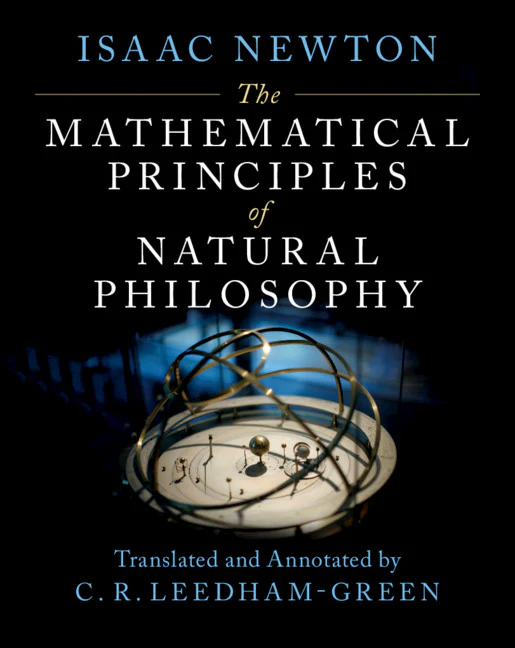
The Mathematical Principles of Natural Philosophy
Newton's Principia is perhaps the second most famous work of mathematics, after Euclid's Elements. Originally published in 1687, it gave the first systematic account of the fundamental concepts of dynamics, as well as three beautiful derivations of Newton's law of gravitation from Kepler's laws of planetary motion. As a book of great insight and ingenuity, it has raised our understanding of the power of mathematics more than any other work. This heavily annotated translation of the third and final edition (1726) of the Principia will enable any reader with a good understanding of elementary mathematics to easily grasp the meaning of the text, either from the translation itself or from the notes, and to appreciate some of its significance. All forward references are given to illuminate the structure and unity of the whole, and to clarify the parts. The mathematical prerequisites for understanding Newton's arguments are given in a brief appendix.
$286.72
The Mathematical Principles of Natural Philosophy—
$286.72
Product Information
Product Information
Shipping & Returns
Shipping & Returns
Description
Newton's Principia is perhaps the second most famous work of mathematics, after Euclid's Elements. Originally published in 1687, it gave the first systematic account of the fundamental concepts of dynamics, as well as three beautiful derivations of Newton's law of gravitation from Kepler's laws of planetary motion. As a book of great insight and ingenuity, it has raised our understanding of the power of mathematics more than any other work. This heavily annotated translation of the third and final edition (1726) of the Principia will enable any reader with a good understanding of elementary mathematics to easily grasp the meaning of the text, either from the translation itself or from the notes, and to appreciate some of its significance. All forward references are given to illuminate the structure and unity of the whole, and to clarify the parts. The mathematical prerequisites for understanding Newton's arguments are given in a brief appendix.